
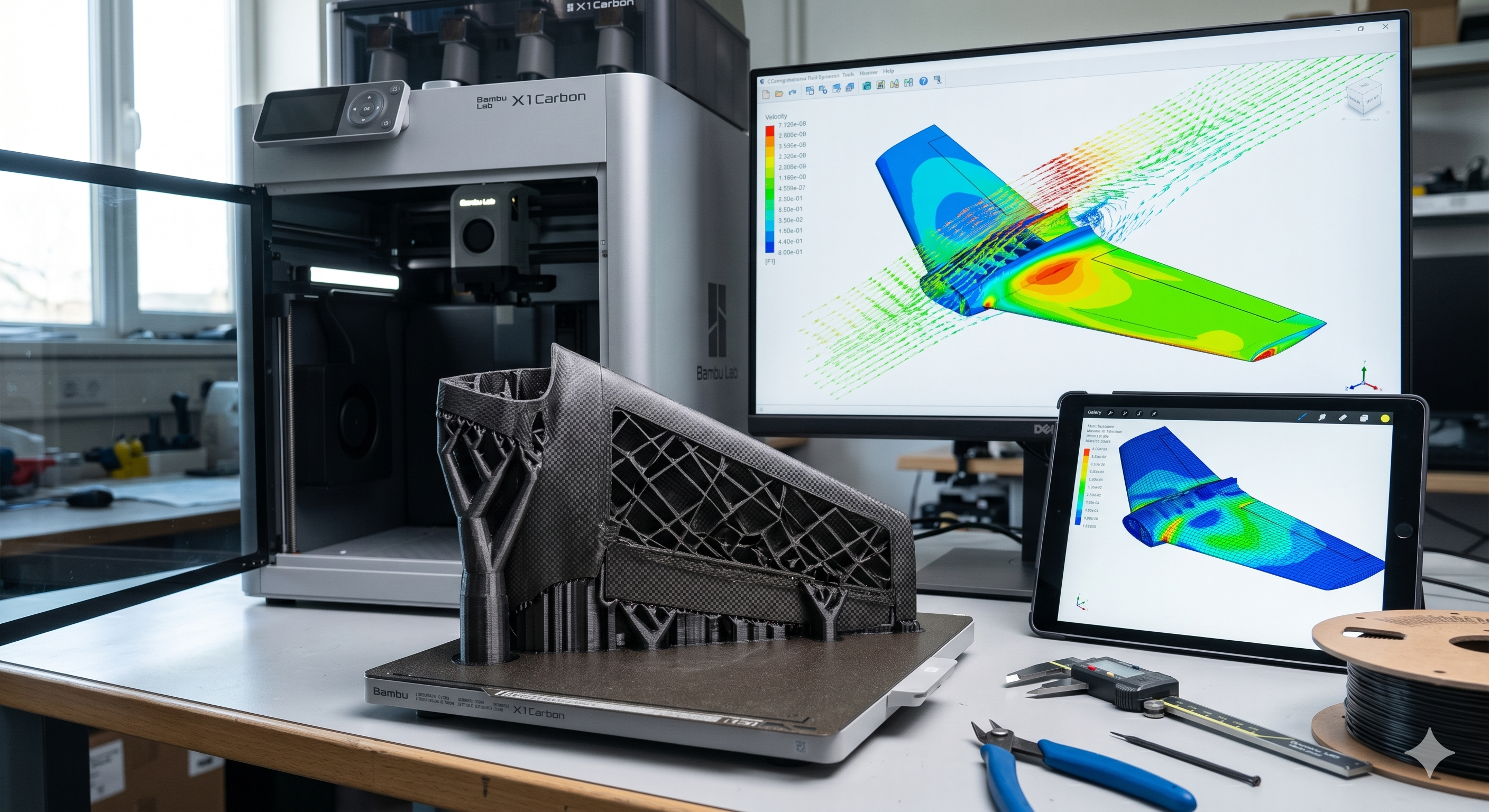
Rapid Prototyping in Aerospace: Maximizing Bambu Lab Hardware for UAV Design
The Bottleneck in Aerospace R&D
In aerospace research and development, the transition from Computational Fluid Dynamics (CFD) modeling to physical testing is traditionally the most time-consuming phase. Waiting on custom tooling or external machining for scale models slows down iteration. However, integrating high-resolution, desktop-scale 3D printing into the engineering workflow changes the equation entirely.
Pushing Desktop Hardware
For current UAV design cycles, we have been utilizing Bambu Lab hardware to bridge the gap between digital models and wind-tunnel-ready prototypes. The advantage isn't just in speed, but in the precision required for accurate aerodynamic validation.
When testing advanced wing profiles or structural nodes for drone show configurations, the surface quality and dimensional accuracy must be flawless.
Key Material Considerations
To get engineering-grade results out of prosumer hardware, filament selection and calibration are critical:
Carbon Fiber Reinforced Polymers (PA-CF / PETG-CF): Essential for printing load-bearing structural joints without excessive weight penalties.
High-Temperature Materials: Necessary for components exposed to motor heat or rigorous environmental testing.
Calibration: Achieving high-fidelity prints requires micro-tuning flow dynamics and cooling profiles specifically for aerospace geometries, where overhangs and thin-wall structures are common.
By bringing this capability in-house, iteration cycles drop from weeks to a matter of hours. This allows for a more aggressive approach to structural analysis and rapid refinement before committing to final, expensive manufacturing processes.